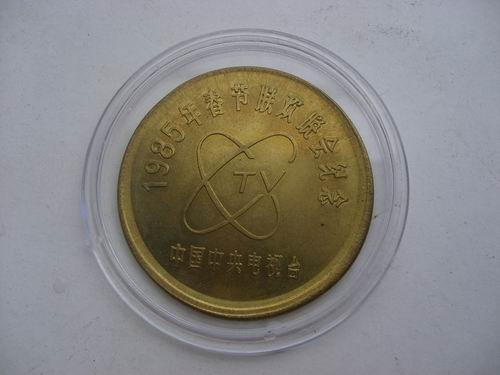
Ever since I argued with badon on the Chinese
Coin Forum and Live Business Chat about the differences between coins and
medals, I myself have gradually gravitated towards medals, including brass ones.
I received some inquiries on my shift of attitude and position. Instead of
answering individually, I hope this post can shed some light on my current
understanding of medals vs. coins. Comments are welcome.
Unlike badon, who denies any difference
between fiat coins and non-fiat medals, I do see a difference between them. So
I still call a coin a coin, and a medal a medal. But (and this is a big
"but"), in terms of the precious metal coins issued by PRC after 1979
(MCC), the difference is minimal and nominal. MCCs were never issued for
circulation. Instead, they have been produced as "artwork for collection"
(from Mr. Zhu Dechun, regarded as father of MCC). In that sense, they are not
very different from medals made for the same purpose. (One of the mistakes in
MCC collection is to compare MCCs to precious metal coins issued for
circulation in the US. This mistake led to many false analogies between the
two, in terms of mintage, grade rarity, and predictions of price trends, among others.
I really want to emphasize that these two are fundamentally different, as one
was meant for circulation, and the other mainly artwork for collection. If
anything, MCCs should be compared to the little known precious metal
commemorative coins in the US, which were first released in 1892 and the
collection of which has not been very popular.)
The main arguments against medal collection
include 1) medals are not officially protected and can be counterfeited without
punishment; 2) medals lag behind coins in price appreciation. Let's examine
these arguments one by one.
First, coins, whether circulating ones or
MCCs, are not immune to counterfeiting. Even newly issued circulating commemorative
coins with a street value of 15 Yuan ($2.5) are faked. Fake coins are sold on
the Chinese Taobao site with no sign of pending official punishment. Punishment
for coin counterfeiting has largely remained as a theoretical deterrent, but
has so far failed to be effectively implemented. The reason may be that
commemorative coins, whether of base metal or of previous metal, are not in
circulation and so their faking poses no threat to the financial system, while
counterfeiting of large face value paper notes is treated seriously, as the
latter are real medium of exchange in life. Whatever the reason, it is a cold
fact that MCCs have not been better protected than medals against counterfeiting.
If we look beyond modern Chinese coins and
medals, we will see that counterfeiting has not stopped people from collecting/investing
in the pre-1949 coins. Coins made from all types of metal, copper, silver and
gold, between the time when milled coins were first introduced to China in the late
19th century, up to 1949, are counterfeited recklessly as there is
virtually no protection for them. Dies to make Fat Man coins are openly available
on Taobao. Cheap fakes flood the market, including eBay. And yet, due to the
pioneering work of early collectors, foreigners included, collection of
"old silver round" as they are known in China has been the most
popular and advanced numismatic category among Chinese coin collection, with detailed
studies of their varieties and huge price gaps between high grade coins –
phenomena observable in US coin collection. It was no coincidence that the
"old silver round" was the first numismatic category to embrace coin
grading in China. With the help of grading companies, the risk of running into
fake coins is greatly reduced if not totally eliminated, as long as one insists
on buying graded specimens.
Second, it is true that many medals have
not appreciated in value as fast as coins. I used the example of the Xinjiang
silver coin vs. medal in my argument against medals when I first brought up the
issue with badon. This is due to the smaller number of medal collectors in the
past. "Medals are lesser than coins", a motto among some Chinese
collectors, becomes a self-fulfilling prophesy. Because medals are regarded as
having less investment value, fewer collect them, which in turn reduces the
demand and drags down the price. However, even with the small number of
collectors, the top rarities among medals have not lost to coins in the same
ranking in price appreciation. Here is a comparison of top silver coins and
medals in a fixed time frame. They are priced in the Chinese Yuan.

(I
am comparing top small size silver coins with top medals because I do not keep
track of prices of large size coins. Those familiar with large size coins can
do a similar comparison. Large size silver coins are not in my range of
collection.)
It is obvious that in terms of price
appreciation, top silver medals have outrun top small size silver coins. The
Jianzhen silver medal set has an even higher rate - close to 40x price growth
since December, 2007. Of course, not all the medals appreciate as rapidly. The
1987 Long Beach Expo silver medal, which sold 100 Yuan more than the Jianzhen
set at the same auction run by the Oriental Auction House in 2007, has appreciated
only slightly in price. Rarity plays a crucial role in price appreciation among
medals due to the smaller collector base. The sharp contrast in price
appreciation between the top medals and more common ones reveals the profile of
current medal collectors: a small number of advanced, well-to-do individuals
who collect both coins and medals alike and are relentlessly in pursuit of the
rarest medals.
In addition to past price appreciation, we
should bear in mind the possibility that the self-fulfilling prophesy "medals
are lesser than coins" may be abandoned by new MCC collectors, thus pushing
the price of the currently undervalued medals way up. Collectors of the recent Chinese
Classical Garden series medals are mostly MCC collectors, too. Is it a sign
that the trend is starting to turn?
Finally, as artwork, officially minted medals
tend to stand out over coins. Coins are strictly controlled in their theme,
design, artistic style, technology and time to market. Low relief is typically
required on coins made in large quantity, for example. In comparison, the same
mint artists designing medals have a lot more freedom to themselves. Zeng
Chenghu spent over a year (on and off) working on his hand-engraved Pagodas,
and Bai Wenjun spent nearly a year on his hand-engraved medal set Plum, Orchid,
Bamboo and Chrysanthemum. The recently released Chinese Classical Gardens
series employed techniques unparalleled in coins, such as double-sided deep
dish and ultra-high relief. Some of the most artistically sophisticated artwork
exists only in the form of copper medals, such as the hand-engraved Guilin
Scenery set. Of course there are exquisitely made MCCs (the first series of
lunars, for example) and poorly made medals, especially those commissioned by organizations
or individuals. But overall the consensus is that medals are artistically more
appealing.
Enjoying wonderful artwork, nice price
appreciation, the vanity of owning and bragging about top rarities, with the
possibility of a huge price breakout in the future – what can be a more
fulfilling experience in numismatic collection and investment?