By Huang Ruiyong
http://bbs.jibi.net/dispbbs.asp?boardid=91&Id=51803&page=3
Posted on August 16, 2006
Good evening everyone. My lectures have been warmly received by you all since they started. I am absolutely grateful. The series, in my humble opinion, is designed to tell the stories behind each exquisite coin. By and by, they will provide spiritual joy to collectors. Today I am going to talk about a recent hot topic in the coin community – Olympics.
But I will not discuss the upcoming Beijing Olympics coins. Instead, I will elaborate on the forerunners of sports coins and Olympics coins from our country – the 1980 coins to commemorate the Chinese Olympic Committee and Winter Olympics. Many collectors may have passed these two sets of coins, but there is a lot to be learned about them. They were issued separately in February, 1980 (Winter Olympics) and June, 1980 (Chinese Olympics Committee). Each set consists of gold, silver and brass coins, in normal thickness and double thickness. Of course they have patterns among themselves, which are top rarities. Let's examine them closely, focusing on gold coins first.
The gold sets have rich characteristics:
1. They were the earliest sports coins from our country;
2. They were the earliest Olympics coins from our country;
3. They were the earliest coins with no country name "People's Republic of China" on it. The text "Chinese Olympics Committee" was used on the obverse in place of the country name.
4. They all had unusual denominations. The Alpine Skiing coin had a denomination of 250 Yuan, matched only by the 8 gram Rooster. The 300 Yuan denomination on Archery was the only one among gold coins, although silver coins with the 300 Yuan denomination are commonplace (for example 1 kilo lunars, 1 kilo pandas and the 1 kilo Soccer).
5. Winter Olympics and the 8 gram Rooster tie for the first place among all the gold coins for the denomination/weight ratio. They are both 8 grams, equal to 1/4 OZ, with a denomination of 250 Yuan. After conversion, the value is 1,000 Yuan per ounce, which was pretty high.
6. The Winter Olympics coins are worth mentioning because they bear the five-ring Olympics logo on both sides. This may be the only use case among all the Olympics coins in the world. It is well known that the five-ring Olympics logo belongs exclusively to the International Olympics Committee, without whose permission, the logo cannot be used at will. But we did. As we were not bound by international laws in those years, we just made use of the logo without much thinking. What could anyone do about it? The same error occurred on the Sword Dancer gold coin from 1988. After that, China showed respect for intellectual property rights and stopped making such mistakes. So in the strict sense, both the Chinese Olympics Committee and Winter Olympics coins are error coins with improper content.
We all know that the piedfort gold coins in these two sets are rarities, but even the thin gold coins are outstanding, too. They were not born at the right moment. Many were melted due to the rapid rise of international gold price. So few thin versions survived in the pristine condition. Their original actual mintages were:
Winter Olympics: 10,143, from Shenyang Mint
Chinese Olympic Committee: 15,019, from Shanghai Mint
So much for the gold coins. Let's turn to the silver coins.
Oh my God, the silver coins even dwarfed the gold coins, because these two silver sets have four patterns between them. Their rarity is beyond description. In the Winter Olympics set, only the woman Speed Skater has a thin version. Thin versions of the other three coins were never officially released. This is reversed in the Chinese Olympics Committee set: only Archery does not have a thin version; thin versions of the other three were officially released.
The distributor of these two sets of coins was International Coins & Currency Inc., often called ICC. As a dealer with 40 years of experience in gold and silver coins described, who was close to ICC, ICC only sold complete piedfort sets (gold, silver and brass) of the Winter Olympics and Chinese Olympics Committee, complete thin sets as well as some odd coins. Jin Weiwei, a veteran dealer at the Lugong Market, had a complete piedfort set not long ago. The imitation mahogany box lined with blue velvet was very eye-catching. But this set disappeared recently. My hearty congratulations to whoever snatched the set.
The thin version of the complete silver set has only four coins: Speed Skater, Ancient Soccer, Ancient Wrestling, and Ancient Equestrian. Why the other four thin version coins were held from release is a topic we want to keep exploring in days to come. Patterns in these two silver sets are absolutely top rarities.
But even the piedfort silver coins are hard to come by. 2,000 sets were struck for the Winter Olympics piedfort silver coins. As for the Chinese Olympics Committee piedfort silver coins, it is said that only 500 sets were struck. Piedfort silver coins in these two sets in perfect conditions are very rare. Why so?
Coins minted by our country in those years were top quality, but the plastic capsules were poorly made. As they did not fit tightly, the coins often dropped out. Some quick people would pick them up with their bare hands, leaving their fingerprints on the coins.
Fingerprints are easy to remove on gold coins with gold cleaners, but cleaning silver coins requires skills. Toning might be damaged if the coin is handled without ultimate care. Silver coins without luster are not appealing to the eye, like a girl's face without the radiance of youth.
I have seen quite a few Winter Olympics and Chinese Olympics Committee piedfort silver coins with toning completely removed, like a human face rubbed with sandpaper for a extended period of time. I just couldn't bear the sight. So when it comes to buying the Winter Olympics and Chinese Olympics Committee piedfort silver coins, to quote a cliché, "Condition, condition and condition".
For the Winter Olympics and Chinese Olympics Committee sets, the little brass brethren are as shiny as the gorgeous gold and silver coins. New China did not produce many proof brass coins in the early days. Besides the 4 Winter Olympics and 4 Chinese Olympics Committee brass coins, the remaining ones include the 1982 brass Soccer, and the 1983-1985 brass pandas. It does not cost a leg to collect them all (the 1985 brass panda would cost both legs now – translator), but they nevertheless come with a sense of success.
A special note: the Winter Olympics and Chinese Olympics Committee piedfort brass coins are the only two sets of piedfort brass coins up to this day. Their significance can never be exaggerated. 1,000 sets were struck for the Winter Olympics piedfort brass coins (based on Shen Jiaju's catalog), and 2,500 sets were struck for the Chinese Olympics Committee piedfort brass coins. It is extremely difficult to find them in pristine condition with splendid luster.
The Winter Olympics and Chinese Olympics Committee sets caught the attention of the world with their unique styles. I have in my collection promotion booklets for these two sets from many years ago. The text was all intriguing. A comment on the Archery gold coin is quoted below:
"Archery, one of the most striking Olympics gold coins in history."
European and American collectors saw it as one of the most unique gold coins in the world, with great admiration. Before Archery, the most unique Olympics commemorative coin was the 1952 Finnish silver coin, with a mintage of 18,500.
Now I have an interesting story for you all. Mr. King Chan in Hong Kong is the number one collector of modern Chinese precious metal coins. His collection is hugely extensive. Before the catalog "Currencies from the People's Republic of China" was published by the Finance Publishing House, facts had to be checked against his collection in his residence. The first coin in his modern Chinese gold coin collection was a Winter Olympics gold coin. It was priced at 2,750 Hong Kong dollars in 1980. It was a very valuable coin sold through Wing Hang Bank. Lo and behold, the current price is lower than its original price, indicating that the price of old coins has not been discovered.
I forgot to highlight the Chinese Olympics Committee piedfort silver coins. Why do they deserve special attention? Well, the Winter Olympics silver coins have the same diameter 33 mm. They do not look unusual with extra thickness. But the Chinese Olympics Committee silver coins are a different story. The Archery coin has a diameter of 23 mm, while the diameter of the Wrestling coin is 28 mm. After thickening, Archery weighs 20 grams, the same weight as Wrestling. No wonder Archery looks very thick, like a small silver cylinder, very cool. Of course, the rejection rate in producing such coins was very high.
Let's remember the names of the following designers.
Winter Olympics Committee:
Obverse: Zhong Youqin
Reverse: Shen Xianzhang, Song Wenyuan, Wang Fude, Li Xiaochuan
Chinese Olympics Committee:
Obverse: Zhong Youqin
Reverse: Tong Youming, Chen Jian, Luo Yonghui, Luo Xingsha, Sun Qiling
These are all masters, representing the highest standards in the design and engraving of precious metal coins in China.
Now let's look at the packaging and COAs of the Winter Olympics and Chinese Olympics Committee coins. In addition to the packaging of the complete piedfort set I mentioned above, typical packaging includes the following:
1. The Archery gold coin is packed with three Chinese Olympics Committee silver coins in a blue square plastic box, lined with blue velvet. Very beautiful.
2. A set of three Chinese Olympics Committee silver coins are packed in a long blue hard box, also lined with blue velvet.
3. A small blue box like a jewelry box (for America), with plush on the outside and velvet lining, used for the Archery gold coin or the Alpine Skiing gold coin. Very exquisite!
4. Red hard plastic box (for Germany) as shown by Youxia, for single Archery or Alpine Skiing gold coins.
COA:
1. A small COA for the Archery gold coin and the Chinese Olympics Committee silver coins was issued by the People's Bank of China, with the national emblem stamped in gold or silver. Very elegant. But there is a small error in the COA for the silver coins. All the denominations of the silver coins were printed as 1 Yuan. The error was later discovered and corrected manually.
2. Colored COA for the Winter Olympics and Chinese Olympics Committee coins, with "Commemorative Coins for the Chinese Olympics Committee" and "Commemorative Coins for the Thirteenth Winter Olympics" on the front, and the signature of Yang Binchao, General Manager of China Mint Company, on the back. This COA is very big.
3. A small yellow English COA for Alpine Skiing, noting ICC as the distributor.
4. A small yellow German COA for Alpine Skiing. The Chinese characters are not in fonts for printing, but in the handwritten form.
Do not overlook the brass coins in these two sets. Now brass coins in perfect conditions are still available at low cost. They will be hard to come by in the future.
These two sets of coins are outstanding from the design perspective. The Winter Olympics coins have a big snow flake as the background on the reverse, perfectly combining the glossy mirror field and the crystal clear ice and snow. On the other hand, the Chinese Olympics Committee coins were designed in the artistic style of stone reliefs from the Han Dynasty, highlighting the national character and leaving an everlasting impression on viewers. Even now these two sets are highly enjoyable.
A well made old coin is like a bottle of nice wine stored in the cellar. The taster needs to know it, understanding the story embodied in it. Then with the cork popping open, the room is filled with its aroma. After all, it is not the wine that intoxicates but the drinker who gets himself drunk.
Let's rank these two sets.
Top rarities
Four patterns: thin versions of the silver coins of Archery, Figure Skating, Alpine Skiing and Biathlon
Four stars and a half
Alpine Skiing and Archery piedfort gold coins
Four stars
Winter Olympics and Chinese Olympics Committee piedfort silver coins
Two stars
Thin version of the Archery and Alpine Skiing gold coins
One star
Thin version of the Speed Skater, Wrestling, Soccer and Equestrian silver coins
Thursday, August 29, 2013
Monday, July 8, 2013
Summary of the Comparative Study on the Terracotta Warrior Coins in the Historical Figures Set
This post is a summary of the comparative
study by Quanmo Yishanren on the pattern coins from the first set of the Historical
Figures series. The original post is rather long and deviating. I am picking
out the essential points from his post at http://bbs.bqcoin.com/read-htm-tid-3378-page-1.html.
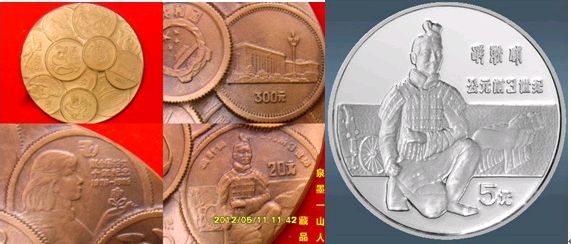
In 1984, Shanghai Mint issued a brass medal
celebrating the 30th anniversary of the new Shanghai Mint after PRC
was founded. (Shanghai Mint itself has a much longer history.) This is the
brass medal:
This medal is interesting because it has
the image of the Shanghai Mint building on one side, and the images of several coins
on the other. The coin side reveals three pattern coins: a pattern for the
Decade of Women gold coin, a pattern for one of the 30th Anniversary
of the PRC gold coins, and a pattern for the Soldier Kneeling silver coin. The
Decade of Women gold pattern was leaked to the market, sold by a coin store
under the China Gold Coins Inc. The 30th Anniversary gold pattern
was very close to the one later released, with difference only in denomination
(300 Yuan vs. 400 Yuan). What Quanmo Yishanren focuses on is the pattern for
the Soldier Kneeling. It is vastly different from the coin actually released:
1. The fonts of the characters are different. The characters "Soldier
Kneeling" are arranged in an arc on the upper left side on the pattern,
while they are horizontal on the upper right side on the released coin; 2. The
characters "Three Hundred Years B. C." on the pattern coin use a
similar font as found on the released coin, but they are in different
positions. On the pattern, the characters are on the upper right corner, in an
arc, while they are horizontally arranged below the characters "Soldier
Kneeling" on the released coin; 3. The denominations are different. It is 20 Yuan on the
pattern coin, on the right middle section of the coin, while it is 5 Yuan on
the released coin, in the lower right corner.
Quanmo Yishanren has the following
questions about the Soldier Kneeling pattern: How come the image of this
pattern got onto the medal? Why the differences between the pattern and the
released coin? Does the pattern still exist today? Where is it?
Quanmo Yishanren then digresses to the
pattern of the gold coin in this set, Qinshihuang. It is the only available
pattern from the Historical Figure series, now in the collection of the Hong
Kong collector King Chan. The image on the right in the picture below is the released coin. The other images are those of the pattern:
While the silver coins were designed and
engraved at Shanghai Mint, the gold coin was designed and engraved by Wang Fude
at Shenyang Mint. The design of the Qinshihuang pattern was very different from
that of the released coin: 1. The pattern shows the full body of Qinshihuang,
with his crown tiling up. The released coin shows only his upper body, with his
crown tilting down. 2. The obverse of the pattern shows the year
"1983" and the characters "Qinshihuang's Terracotta Warriors from
China" in the Qinzhuan font, with the image of the Great Wall in the
background, separated into two sections. On the other hand, the obverse of the
issued coin has the name of the country, the national emblem and the year
"1984", which are standard design elements. 3. On the reverse of the
pattern coin are the image of Soldier with a Horse, the 100 Yuan denomination,
the characters "Soldier with a Horse" in the Weibei font and the
characters "3rd Century B. C.", while the reverse of the
released coin has the image of Qinshihuang, the denomination of 100 Yuan, the characters
"Qinshihuang" in the Qinzhuan font, and the characters "Years
259-210 B. C." in the Kaishu font.
Quanmo Yishanren then proceeds to compare
the pattern of Qinshihuang, the brass medal of the 30th Anniversary
of Shanghai Mint and the silver coins of the terracotta warriors.
He believes that through
logical inference, the following questions can be asked: 1. Now that Soldier
with a Horse is on the reverse of the Qinshihuang pattern, it is very unlikely
that the same design would be used on a silver coin. What would the design on
that coin be? 2. The Qinshihuang pattern has the year "1983" on it.
Accordingly, the year on the Soldier Kneeling silver pattern should be the
same. Where would it be positioned? 3. We only see the design on the reverse of
the Soldier Kneeling. Based on the designs on the Qinshihuang pattern, Quanmo
Yishanren believes that the design on the obverse of the Soldier Kneeling would
be different from that on the officially released coin. These questions need to
be investigated.
Quanmo Yishanren then contacted the designers and
engravers of the coins and the brass medal. Unfortunately, they had not even
noticed the facts, especially the patterns on the brass medal. They had very vague
memory of what happened so long ago. What can be concluded are:
1.
The images of the coins on the
brass medal were based on original dies from the die room, although reduced in
size. The three patterns were minted for the release of the coins. The released
coins are different from these patterns for review because of the input from
the distributor or China Mint Company.
2.
The patterns were all actually
minted, but in a very small number. They were primarily submitted to China Mint
Company and the overseas sponsor of the project. Under the chaotic management system
of that time, patterns submitted were rarely recovered. The recipients of
patterns would pay for them. That is to say, these patterns actually
became commodities. Those patterns retained within the mint were melted
under supervision.
3.
After so many years, any such pattern
would be a highly valuable top gem if it shows up. It may be the only specimen available. Even
if such patterns happen to turn up in a managed way, they are still extremely
rare, well worth collecting and researching.
4.
Because of the specific historical
theme, the Qinshihuang and Soldier Kneeling patterns are outstanding even among
pattern coins.
5.
The fact that images of pattern
coins appeared on the brass medal was due to negligence. This will not happen
again as patterns are under strict management now.
Tuesday, June 11, 2013
Trial Strikes: A Logical Analysis of and Empirical Inference on a Secret of Dragon Coins
By Quanmo Yishanren
05/23/2013
05/23/2013
http://bbs.bqcoin.com/read-htm-tid-3280.html
This article will reflect on the dragon
culture and dragon coins in China, focusing on the logical analysis of and
empirical inference on a unique phenomenon of dragon coins. The purpose is to
lift the shroud on a mystery and to explore the culture and varieties of
Chinese precious metal coins. Reader comments are welcome, so that the subject
can be studied in depth and the issue further researched.
I.
Dragon Culture and Dragon Coins
(Omitted – translator)
II.
Highlight and Mystery of the
1988 Lunar Dragon Coins
1988 was a year in the Chinese numismatic
history that deserves close attention, because it was not only the first year
after the formal founding of the China Gold Coin Inc. on December 22, 1987, but
also the Year of Dragon in the lunar calendar system. The Central Bank started
the 1 oz, 5 oz and 12 oz gold coin types when releasing the lunar coins, which
have been very popular among Chinese gold coins. Among the small number of gold
and silver coins of the year, many have been the topics of conversation up till
today. It is not an exaggeration to say that error coins, error medals,
patterns and world award winning coins all happened to make their appearance this
very year! These include the error coin of the 15th Winter Olympics
silver coin (mistaken for 16th), the error commemorative gold medal
for the Basel Coin Week, the wrong use of the design on the 24th
Olympics gold and silver coins as well as the rumor of their patterns, the rare
phenomenon on the design on the obverse of the 1988 5 oz silver panda, and the
mystery of the lunar Dragon coins. Among these, the Dragon coins are quite an
eye opener!
Although we are only 25 years away from
1988, the time through the quarter of a century obliterated many facts,
including the complete historical information on the approval, production and
sales of the lunar Dragon coins. Against the fast moving China and Chinese gold
coins after the reform and opening up, everything seems to be fading away with
the passage of time. If we fail to dig out and comb through historical data in
a timely fashion right now, we will leave even more doubts and bigger mysteries
to the next generations. If we are lucky, we can manage to restore the truth in
the coming days. The mystery of the varieties of the 1 oz Dragon coins is one
such case.
1.
Outstanding Year of Dragon
Coins
Among the 1988 Dragon coin types, the 1 oz
and 12 oz coins were minted by Shanghai Mint. The theme of twin dragons playing
a ball was taken from the artistic work on the Nine Dragon Screen in the
Imperial Garden. The design came from Mr. Zhu Dechun, who is now deceased. The
12 oz coin was engraved by Mr. Zeng Chenghu of Shanghai Mint, and the 1 oz coin
was engraved by Mr. Yi Shizhong, who was working for Shanghai Mint then. For
that matter, the design of the twin dragons playing with a ball on the 1 oz
platinum, gold and silver coins was slightly different from that on the 12 oz
gold and silver coins.
Later, it was proved that the 1988 lunar
Dragon coins were more than outstanding. The 1 oz gold, silver and platinum
coins became the flagships of their respective series. Moreover, the 12 oz
silver coin won the "Best Silver Coin" award at the 1990 Klaus and
World Coin News World Coin Grand Prix. Even today, the 1 oz piedfort silver
lunar coins series, with its start in the Year of Dragon, are still chased by
lunar coin collectors.
2.
Mystery Surrounding the 1 Oz Lunar Dragon
Coins
Interestingly, the two obvious varieties of
the 1 oz gold and silver Dragon coins gradually caught collectors' attention.
As officials keep their mouth shut, common folks have different
interpretations, including the so-called "large date" and "small
date" varieties, with the large dates from Shenyang Mint. Other claims
include sighting of the large date gold coins in a ten-piece plastic sheet, and
large date platinum Dragon coins.
a.
Initial Exploration of the
Varieties of 1 Oz Lunar Dragon Coins and Counter Argument
Despite the different views in the
collector community, the first person who focused on this issue was Mr. Ge
Zukang. He contributed a special post "On the Different Minor Varieties of
1988 Lunar Year of the Dragon Gold Coins" (http://bbs.jibi.net/dispbbs.asp?boardid=70&Id=204471)
in July, 2010, thus opening a door for discussing this issue. Only Mr. Ge
missed a couple of points in our current view when he discussed the varieties
of the 1 oz Dragon coins, probably because it was the first time for him to
touch on this issue: First, he defined the varieties of the Dragon coins as
minor. In my view, these different varieties are far from minor. (I have my own
definitions of major and minor varieties. Those interested can refer to
http://bbs.chngc.net/forum.php?mod=viewthread&tid=42969&extra=)
Secondly, in the varieties that Mr. Ge analyzed, Zeng Chenghu Variety 1
actually does not exist. It is a picture taken from the official catalogs of
the China Gold Coin Inc. There is no such physical coin. (Just in passing, there
is no shortage of similar official pictures from China Gold Coin Inc. Although
some are indeed pattern designs, more are just distorted pictures.) The Yi
Shizhong Varieties 2 and 3 are actually the same, the only difference being that
Variety 2 is a picture of the coin, while Variety 3 was the physical coin. That
means that only Yi Shizhong Varieties 3 and 4 actually exist. Third, it is not
quite right to call them Yi Shizhong varieties, because the difference is on
the obverse, and the obverse was not engraved by Mr. Yi Shizhong. The so-called
"large date" variety not only has a large date, but all the other
details are different. It is because the obverse of the so-called "large
date" 1 oz Dragon coin was taken from the obverse of the 1 oz Panda gold
coin of that year. The designer of the obverse and reverse of the 1988 1 oz
Panda gold coin was Mr. Yan Jingkui. (The 1986 Panda gold coin designed and
engraved by Mr. Yan Jingkui won the "National One Hundred Flowers Award
for Arts and Crafts".) The engraver of the non-large date variety of the 1
oz Dragon coins was Mr. Chen Jian of Shanghai Mint, who engraved the obverse of
the 1982-1984 and 1987 Panda gold coins. In this sense, the so-called Yi
Shizhong Varieties 2 and 3, which are the non-large date Dragon coins, should
be Chen Jian Variety, and the Yi Shizhong Variety 4, which is the so-called
"large-date variety", should be Yan Jingkui Variety.
b.
Further Investigation of the 1
Oz Lunar Dragon Coins
We have gained a basic understanding of the
1988 1 oz lunar Dragon coins. But a crucial question arises for the masses of
coin collectors and researchers: Why did two varieties of the 1 oz Dragon coins
turn up, the Yan Jingkui Variety (Yan Variety for short) and the Chen Jian
Variety (Chen Variety for short)? What is their significance and what was their
respective mintage?
In fact, before looking further into these
questions, we have to bring up the 1 oz piedfort Dragon silver coin and the 1
oz Dragon platinum coin, because so far, in addition to the common Chen Variety
1 oz piedfort silver Dragon, we have observed on the market the more scarce Yan
Variety 1 oz piedfort silver Dragon. Moreover, the difference between the Chen
Variety and the Yan Variety piedfort silver coins is not limited to the
obverse. The designs of two dragons playing a ball on the reverse are obviously
different, which does not exist on the gold Dragon coins of the Chen and Yan
Varieties. It is rumored that someone saw the platinum Dragon coin of the Yan
Variety. I am not going to dwell on it since I have never seen it. As for the
official coin pictures of the 1 oz piedfort silver Dragon, the only record available
is in the official book The Printing and Minting of Modern Chinese Currencies,
published by the China Financial Publishing House in 1998. In addition to the
picture of the silver coin of the Yan Variety on page 147, it specifically
mentions the few "new technological successes for our country's
commemorative coins through continuous research and experiment……'Two dragons
playing a ball' proof lunar gold and silver coins were first released in
1988" in Bullet 3 of "Minting Technologies" under the minting
"Exploration and Innovation" section on page 150.
This shows that the Chen and Yan Varieties
not only exists on the 1 oz gold coin, but also on the 1 oz silver coin, and
probably on the platinum coin. Returning to the topic above, why did these
varieties occur?
Through inquiries to those involved, and
based on official written data available for perusing now (which are my own methods
of research), the basic conclusion is: the Yan Variety Dragon coins were trial
strikes from the need to test technologies in the trial production of coin
types of these specifications. This is my basic understanding of the coin types
after excluding them from the possibilities of fakes, error coins or special
strikes, and this understanding is agreed on by Shanghai Mint. The answer from
the mint to my conclusion that the 1 oz Dragon coins were trial strike is: it
was the first time for the mint to produce coin types of these specifications.
Due to the lack of technical readiness and time crunch, the die of the obverse
of the Panda gold coin of the year was used temporarily in the trial production
of the Dragon coins. By the time of formal production, the matching obverse design
was still not available. As it was considered improper to use exactly the same
design as the obverse of the Panda gold coins of that year, the obverse of the
1987 Panda gold coin was adopted, which was also a world renowned classic
design. The 1 oz lunar coins started to have a uniform obverse design of the
national emblem with flowers from the 1989 Snake coin to the 1999 Rabbit coin.
In fact, as far as the possibilities I can come up with, I feel that apart from
technical considerations, decision-making and human relations during that particular
historical period might also have played a role in the background of this
issue. Of course the actual happenings on this perspective are difficult to
investigate, and it might not be a good idea to do so as our focus is on the
varieties themselves.
Has our current understanding of the coins
as trial strikes added new members to the rank of Chinese precious metal coin
patterns on the market, with interesting and simultaneous appearance of coins
made of gold, silver and platinum? It may not be that simple, because there are
different views on Chinese precious metal coin patterns in the trade, especially
among coin collectors. These differences arise on the nature of patterns, their
categorization and their valuation. We can refer to the patterns of milled
coins of the pre-PRC times in our understanding and determination of Chinese
precious metal coin patterns, but they are also distinctly different. Those
patterns of milled coins of the pre-PRC times are no longer under the legal
protection of our country, and so many of them are fakes (as their steel dies
are available at auctions) with no legal protection. On the other hand, the
patterns of Chinese precious metal coins, as the currency issued by the current
regime, are not suffering from this weakness. Yet they are faced with another
dilemma: according to the applicable law of our country, patterns of issued
coins are confidential, while patterns of unissued coins are top secrets. Under
these conditions, what is the proper perspective on patterns? Thanks to the
unique circumstances during the specific historical period, some patterns of
early Chinese gold coins still turn up on the market, get circulated and fall
into strong hands. This is a highly interesting numismatic phenomenon deserving
close watch! It is worth further exploration in the future.
A related question is the quantity of the
patterns. Based on the consensus on the market and in the collector community,
patterns of Chinese gold coins are very small in number! Without agreement on
the nature and concept of patterns, some would claim that a pattern should be
the only specimen; others say that patterns normally come in four. The 1989
Dragon and Phoenix and the 1992 Dragon and Horse are relatively larger in
number with undetermined quantity, but still remain extremely rare. These facts
remind us that our understanding and research of patterns still need
improvement! As for the number of the 1 oz Dragon coins of the Yan Variety, we
cannot decide on their individual mintage, but based on the norm of trial
strikes at that time, they should be very small in number – currently, it is
mostly the 1 oz gold Dragon coin of the Yan Variety that is sighted once in a
while. Even though trial strikes do not have a fixed number in production, i.e.
they can be more or less, depending on how soon the specifications are met,
what is the largest number by estimate? According to those working at the
mints, the maximum number of trial strikes is a few dozen. Of course, when it
is hard to find the number in the records, we can let time solve the puzzle as
it flows on. The purpose of my focusing on this topic and of my research is to
promote and expand the awareness among more people, so that owners of these
coins will come forward. That will take us closer to truth!
c.
Looking Deeper into the Mystery
of the Varieties of the Lunar Dragon Coins
Apart from previous discussions, the
following question may be asked: since the design, production and melting of
trial strikes follow a relatively strict procedure, how did the 1 oz Dragon
coins of the Yan Variety survive melting and make it to the market, if they
were indeed trial strikes?
With our holistic view of the Chinese
precious metal coins during the 80s and 90s, my conclusions through
comprehensive observation and investigation include the following: (1). This coin
is not unique in getting to the market. Other trial strikes are available on
the market, too. Even trial strikes of gold coins with the wording
"Pattern" on them have been sighted. Some trial strikes currently deemed
extremely rare were sold from official channels. For example Quanyouzhai (name
of an official coin outlet – translator) sold the gold trial strikes of the
Decade of Women. (2). The business meeting held on October 20, 1995 by China
Gold Coin Inc. to focus on the inventory of gold and silver commemorative coins
(on page 29 of Annual Book of China Gold Coin Inc., 1987-2007) specifically
cited what needed to be removed from the coin inventories, which included two
categories of gold and silver coins: those not minted according to approved
patterns and those minted beyond the planned mintage. In 2002, the China Gold
Coin Inc. monitored their melting following the document Approval of Melting of
Some Gold and Silver Commemorative Coin Inventories from the Gold and Silver
Division of the Central Bank. This proves that the Dragon coin of the Yan
Variety was not a unique case. (3). As a legal entity, the China Gold Coin Inc.,
registered and founded at the end of 1987, did allow for leeway for such coins
to be marketed due to ownership and similar issues in its own process of
adopting independent accountability and self-financing.
Although I cannot claim that the mystery of
the 1 oz Dragon coins is totally cleared up for now, at least we have a better
understanding of this issue. Or we can say that another window is opened to
gain more knowledge about it. The Numismatic Society of Shanghai Mint has
included these coins in their study after I contacted them for information. It
is said that the Rongli Institute in Shanghai (under the management of Huang
Ruiyong – translator) is also working on them. I hope more people can join the
research on this coin, and reach more solid and convincing conclusions!
III.
The Motivation and Purpose of My
Research on the 1 Oz Dragon Coins
I have three motivations/purposes in the
research of the 1988 1 oz Dragon coins as an individual case of study:
First, through this case study, I wish to
explore the mechanism of some phenomena associated with early Chinese gold
coins, so that I can better grasp similar phenomena and trigger collective
reflections and explorations by fellow collectors of Chinese gold coins as an attempt
of empirical study and cultural development. This case study in particular can
enrich and deepen my knowledge of Chinese numismatics. The publication of my initial
research findings can trigger discussions, which may in turn lead me as the researcher
to more findings! Of course, by sharing the findings, more people will stand to
gain knowledge or benefit.
Second, through this research, I wish to
gain better understanding and a more rational estimate of the trial strikes of
Chinese gold and silver coins. At present, it seems that trial strikes are
deemed extremely elusive and expensive, beyond the reach of common folks. The reality
may be very different. Although there is a big gap between the numismatic
culture and valuation of coins of our country and those countries relatively
more developed, we in fact have our originality and a solid foundation in
numismatic research. What we need is the building of a Chinese gold coin
culture and expansion of the market, based on correct understanding of the
coins and of ourselves.
Third, this study opens our eyes to many anecdotes
and research subjects previously unknown or unfamiliar to us. These anecdotes
are extremely interesting, and the research subjects offer chances of great
value. For those who are devoted to the enjoyment and study of coins, these
research subjects are well worth watching out for and getting deeply involved in,
which in turn will greatly accelerate the evolution of Chinese gold coins and the
numismatic culture.
Nine Dragon Screen (added by translator)
Saturday, May 18, 2013
Research Article: Explore the Actual Mintage and Restrikes of Precious Metal Coins from the PRC
By Huang Ruiyong
http://bbs.jibi.net/dispbbs.asp?boardid=91&Id=119905
Generally speaking, actual mintage is a number in contrast to planned mintage. Just as the name suggests, actual mintage is the actual number of a coin or medal actually minted. In the case of modern Chinese precious metal coins, actual mintage is highly significant, because it reflects very vividly the release history of modern Chinese precious metal coins. As we all know, the primary function of the early modern Chinese precious metal coins was to bring back foreign exchange, while promoting Chinese politics and culture worldwide. Except for coins for important political events, many coins before Year 2000 were initiated by overseas distributors, who came to the People's Bank of China for approval and announcing the release. Then they would seek out Shanghai Mint, Shenyang Mint or Shenzhen Guobao Mint for production before distributing the coins. For example, the Historical Figures series gold and silver coins were distributed by MDM in Germany; 8 gram lunars and dodecagonal Birds gold and silver coins were distributed by the Hong Kong Peking Coin Company Limited; the Guilin Scenery gold and silver coins were distributed by Ocean Gold Coins in Hong Kong; the Ancient Inventions and Discoveries series were distributed by PandaAmerica; the early Guanyin series gold and silver coins were distributed by Chien Hsiung Liu Co. in the US; the Unicorn series were distributed by Assets Marketing Co; the Silk Road series gold and silver coins were distributed by ING in Belgium… Fortunately, after Year 2000, distribution of Chinese precious metal coins was consolidated. Almost all the products have been distributed by the China Gold Coin Co., to the Kaiyuan Retail Center in Beijing, Shenzhen Retail Center, Hong Kong Great Wall Coins Investments Ltd., as well as MDM in Germany and PandaAmerica.
In the early years, the distributors proposed different product specs and planned mintage for precious metal coins because their capacity and channels varied. Under normal circumstances, the distributor would generally avoid producing the full planned mintage, because 1. They wanted to test market reaction to the coin; 2. They had to put together a large amount of money for the material and manufacturing cost. The distributor would ask for termination or suspension of production of a certain coin if the following occurred:
1. The market did not react favorably to the coin;
2. The distributor's business operations and cash flow were disrupted;
3. Management team change at the People's Bank of China, the China Gold Coin Co. (or China Mint Company) or the distributor.
When this happened, the concept of actual mintage, which is on every collector's mind, would come into the focus.
With this explanation of actual mintage (original actual mintage), we all see that actual mintage has a big impact on the assessment of the rarity of a certain coin, because it is the essence of collection that rarity determines the price. But we may be concerned with two more questions at the same time:
1. How are the data of actual mintage of various precious metal coins obtained?
2. How do we treat the rumor widespread on the web of restrikes by Shanghai Mint of some types during 2001 to 2005?
Here are my answers to the two questions above:
1. The data on actual mintage has to be verified by using materials from many sources. This is a dynamic verification process. So far, no institutions or individuals have been able to come up with accurate actual mintage numbers of all the precious metal coins from the PRC. This problem resulted from the overwhelming power of the distributors before 2000, who could directly influence the entire process of project approval, announcement, production and sales. Moreover, domestic supervisory and production organizations did not maintain complete, systematic records. In this light, in order to obtain a clear understanding of actual mintage, the following needs to be investigated:
Historical distribution records of the these companies: China Mint Company, China Gold Coin Co., China Coins Limited;
Historical production records of these organizations: Shanghai Mint, Shenyang Mint, Guobao Mint, Swiss Faude & Huguenin, Swiss Pamp Mint, Swiss Vacambi Mint, and Perth Mint of Australia;
All the sales records of distributors and retailers, including: Hong Kong Great Wall Coins Investments Ltd., Peking Coin Company Limited, PandaAmerica, MDM of Germany, Japanese Taisei Coins Corporation, ING of Belgium and so on.
This is a very arduous and complex process, which must be treated with absolute seriousness. Through the collaboration of both official and civilian efforts, the issue of actual mintage is expected to be worked out for the most part.
2. Restrikes of some coins by Shanghai Mint after Year 2000 are described as follows:
According to records in the Yearbook of Shanghai Mint (2002-2003), Yearbook of Shanghai Mint (2004), Yearbook of Shanghai Mint (2005) and Yearbook of Shanghai Mint (2006), all the restrikes of coins before Year 2000 are listed below, in Table 1, 2 and 3:
(The tables are translated, merged and formated in this link: http://china-mint.info/forum/index.php?topic=18.msg15153#msg15153)
OK. Let me explain the restrikes from Tables 1 to 3.
First of all, restrikes are not unique to China. Other countries in the world also make restrikes, but they all exercise extreme caution when doing so. Here is an example. When Hong Kong issued lunar gold coins years ago, wild speculations followed because of the limited mintage, and the price skyrocketed. The British Authority in Hong Kong immediately decided to restrike the balance in the planned mintage, which contributed to the stabilization of the price.
Now let's take a look at the explanations from the currency issuing authorities on the restrikes of precious metal coins. The following quotations are from an administrator of the Gold and Silver Currency Division of the People Bank of China:
A. For precious metal coins issued in the years of China Mint Company (i.e. before 1987), China Gold Coin Co. cannot apply for restrikes even if the planned mintage was not fulfilled, because these were different projects managed by two organizations, unless the precious metal coins had a theme that carried over from China Mint Company to China Gold Coin Co. (such as Historical Figures gold and silver coins). That is to say, independent themes before 1987, such as the 1983 Marco Polo gold and silver coins, the 1986 Year of Peace gold and silver coins will be excluded from restrike applications from China Gold Coin Co.
B. For precious metal coins issued by the People's Bank of China and distributed by China Gold Coin Co., sufficient reasons must be provided for restrikes, to be approved by the Gold and Silver Currency Division of the People's Bank of China. Moreover, if the quantity of the requested restrikes is too small (below 5,000 pieces in one application), the proposal for restrikes will most likely be rejected. (Comment: this information will make collectors happy who follow the natural law of collection, because many types with a small mintage will not be restruck. The original actual mintage becomes an excellent reference).
C. Starting last year, all the newly approved precious metal coins will not be announced by the People's Bank of China if less than 70% of the planned mintage is met, and certainly will not be approved for production. If the newly approved precious metal coins reach 70% of the planned mintage, the balance can be restruck, but the approved restrike window is one year. (Comment: this information will make collectors feel certain about the release mintage of new coins.)
We cannot talk about restrikes without mentioning the other important term: melting. Melting is exactly the opposite to restriking. What are the historical records of melting in official books? 2007 was the 20th anniversary of the founding of China Gold Coin Co. In the book "History of China Gold Coin Co." written by the editorial committee of the book, cases of past handling of precious metal coin and medal inventories by the China Gold Coin Co. are clearly laid out:
The first time occurred on October 20, 1995. China Gold Coin Co. called an official meeting to focus on the inventories of gold and silver commemorative coins. The meeting decided that: the production facilities would check large size panda silver coins (including 5 oz and 12 oz ones) minted before 1993. Twenty specimens would be preserved. Any surplus over that would be melted.
The second time was the 2002 official reply from the Gold and Silver Currency Division of the People's Bank of China on the melting of some of the commemorative gold and silver coin and medal inventories. (Document No. 20 in 2002 by the Division). This official reply required China Gold Coin Co. to melt some of the gold and silver coin inventories, all the gold and silver medals and all the patterns of unreleased gold and silver coins. Shanghai Mint and Shenyang Mint were asked to monitor the melting of the gold and silver coin and medal inventories. Between these two mints, Shenyang Mint was responsible for monitoring the melting of: 111,593 gold coins and medals, 251,564 silver coins and medals, and 3,909 bi-metal coins, which contained 794 kilograms of gold and 7,358 kilograms of silver. Shanghai Mint was responsible for monitoring the melting of: 108,814 gold coins and medals, 188,275 silver coins and medals, and 16 bi-metal coins, which contained 916 kilograms of gold and 6,228 kilograms of silver. (Comment: this happened exactly as China Gold Coin Co. was implementing a policy of quality products with strict control of quantity. The scope of this move was totally unexpected. We may say that with this large scale melting, China Gold Coin Co. depleted most of its inventories.)
Now let's go back to the restrikes in Tables 1 to 3:
A. In 2003, the kilo gold Tang Dynasty Vault Protector was restruck. The kilo silver Tang Dynasty Vault Protector was restruck in 2003 and 2004. The Tang Dynasty Vault Protector coins were distributed by Hong Kong Peking Coin Company Limited (later on renamed as Hong Kong China Coin Company Limited). When the coins were first marketed in 1998, the coin market was very slow. The distributor later on requested restrikes to make up for their loss. Peking Coin Company Limited was a long-time business partner of China Gold Coin Co. The 8 gram lunars distributed by them were a huge success. Afterwards, the company made their name with lunar coins. The restrikes of the Tang Dynasty Vault Protector coins were a special case of a market compensation contract. If restrikes could be used to make profits, Peking Coin Company Limited would have taken advantage of their strong public relation skills and asked Shenyang Mint to mint 8 gram gold Rat at full speed.
B. The 1999 Water Spraying Guanyin coins are gold gilt silver coins. According to informed sources at Shanghai Mint, the condition of the coins in the warehouse was horrible because of bad storage environment. When China Gold Coin Co. came to pick up the order, the condition of the coins was considered below the standards of fiat currency. Shanghai Mint melted all the inventory, and then re-minted the same number of coins as melted.
C. We may notice that the Historical Figures silver coins were continuously restruck. This is why we find brand new complete sets of Historical Figures silver coins at Lugong and Madian markets. There was a big story behind this set, as those were no ordinary restrike orders. The original distributor of this set was MDM in Germany. In the catalog of precious metal coins and medals by Mr. Ge Zukang, the actual mintage was very different from the planned mintage. But later on, MDM got in contact with a Hong Kong businessman by way of a coin dealer at the Lugong Market, and obtained the approval for restrikes through China Gold Coin Co. after many twists and turns. The quantity of the restrikes was very surprising. This restrike plan stirred up a lot of noise (the People's Bank of China was not aware of these restrikes at first). For this reason, managers at China Gold Coin Co. responsible for the project were moved to other positions in order to cool down complaints. This set of coins will have more restrikes as it was an international project with the contract already in place.
D. The Silk Road silver coins were restruck in 2004 and 2005. The distributor of this set was ING in Belgium. It was another international project, similar to the Historical Figures silver coins. As the contract was already in place, there was no option but to restrike the coins.
E. Two specimens of the 1987 12 oz gold Panda, the 1991 12 oz gold Panda and the 1996 20 oz Unicorn were restruck in 2004. These were normal restrikes, as they were needed for China Gold Coin Co. to showcase the coins.
With all this knowledge, we now have a better understanding of the actual mintage and restrikes, instead of seeing restrikes as fearful threats. We now know that theoretically, all the precious metal coins are likely to be restruck in the future if the actual mintage falls short of the planned mintage. But in fact the possibility of restrikes will diminish, to the degree of being negligible, because the Banking Law of the People's Republic of China and the Regulations on Renminbi of People's Republic of China will be further refined. As fiat currency, the approval, production and sales of precious metal coins will be further regulated. Restrikes will have a political impact. As collector and researchers, we need to understand the reason for restrikes of some individual coins. Also, after learning about restrikes of these coins, we should know that occasional restrikes of such coins cannot be viewed as the harbinger for restriking all the precious metal coins, just as we do not rush to get rid of all our color coin collections when we occasionally find a lot of color paint peeling off on one color coin.
Finally, precious metal coins from the PRC usually have a smaller actual mintage than the planned mintage. With early coins, the actual mintage was far lower than the planned mintage, such as the 1/2 oz gold Ancient Maritime Ships and the 1 oz gold Sun Yat-Sen. We often see the actual mintage exceeded the planned mintage by a few or a few dozen specimens. Don't panic. The extra specimens were patterns. For example, the 5 oz gold Huangdi Mausoleum had a planned mintage of 99, but the actual mintage was 100. The extra specimen was a pattern. Another example is the 5 oz Longmen, which had a planned mintage of 288. But the actual mintage was 292. Again the extra 4 specimens were patterns. Among the precious metal coins from the PRC, there were a couple of cases where the actual mintage was more than the planned mintage by 10%, but this is very rare.
Conclusions:
Actual mintage is an important parameter in the collection of precious metal coins from the PRC. It reflects their history at the same time. The dynamic change of the actual mintage of a certain type is closely related to restrikes. For new collectors, they can start on their journey of value collection and value investment by getting to know the planned mintage of the precious metal coins. Here is an example. In 1989, China issued a palladium panda coin. This was the only palladium panda coin in the whole world in the 20th century. The planned mintage was 3,000. However, because of the political events of that year, the actually mintage was only 1,367. When the price of palladium shot up a few years ago, the distributor, Mr. Lim Beng Haw, melted a lot from his inventory, leaving the coin all the more rare. Even if the new collector does not know about the actual mintage and melting, he or she can determine that the coin is well worth collecting based merely on the planned mintage and the fact that it was the only palladium panda coin in the 20th century. For each and every coin issued by PRC before the 21st century, the information on their approval, production and distribution is far from complete, which demands great efforts for us to research them carefully and continuously. We all have to pitch in and collect valid information from all channels, before finally establishing a systematic and complete academic theory on precious metal coins from the PRC.
http://bbs.jibi.net/dispbbs.asp?boardid=91&Id=119905
Generally speaking, actual mintage is a number in contrast to planned mintage. Just as the name suggests, actual mintage is the actual number of a coin or medal actually minted. In the case of modern Chinese precious metal coins, actual mintage is highly significant, because it reflects very vividly the release history of modern Chinese precious metal coins. As we all know, the primary function of the early modern Chinese precious metal coins was to bring back foreign exchange, while promoting Chinese politics and culture worldwide. Except for coins for important political events, many coins before Year 2000 were initiated by overseas distributors, who came to the People's Bank of China for approval and announcing the release. Then they would seek out Shanghai Mint, Shenyang Mint or Shenzhen Guobao Mint for production before distributing the coins. For example, the Historical Figures series gold and silver coins were distributed by MDM in Germany; 8 gram lunars and dodecagonal Birds gold and silver coins were distributed by the Hong Kong Peking Coin Company Limited; the Guilin Scenery gold and silver coins were distributed by Ocean Gold Coins in Hong Kong; the Ancient Inventions and Discoveries series were distributed by PandaAmerica; the early Guanyin series gold and silver coins were distributed by Chien Hsiung Liu Co. in the US; the Unicorn series were distributed by Assets Marketing Co; the Silk Road series gold and silver coins were distributed by ING in Belgium… Fortunately, after Year 2000, distribution of Chinese precious metal coins was consolidated. Almost all the products have been distributed by the China Gold Coin Co., to the Kaiyuan Retail Center in Beijing, Shenzhen Retail Center, Hong Kong Great Wall Coins Investments Ltd., as well as MDM in Germany and PandaAmerica.
In the early years, the distributors proposed different product specs and planned mintage for precious metal coins because their capacity and channels varied. Under normal circumstances, the distributor would generally avoid producing the full planned mintage, because 1. They wanted to test market reaction to the coin; 2. They had to put together a large amount of money for the material and manufacturing cost. The distributor would ask for termination or suspension of production of a certain coin if the following occurred:
1. The market did not react favorably to the coin;
2. The distributor's business operations and cash flow were disrupted;
3. Management team change at the People's Bank of China, the China Gold Coin Co. (or China Mint Company) or the distributor.
When this happened, the concept of actual mintage, which is on every collector's mind, would come into the focus.
With this explanation of actual mintage (original actual mintage), we all see that actual mintage has a big impact on the assessment of the rarity of a certain coin, because it is the essence of collection that rarity determines the price. But we may be concerned with two more questions at the same time:
1. How are the data of actual mintage of various precious metal coins obtained?
2. How do we treat the rumor widespread on the web of restrikes by Shanghai Mint of some types during 2001 to 2005?
Here are my answers to the two questions above:
1. The data on actual mintage has to be verified by using materials from many sources. This is a dynamic verification process. So far, no institutions or individuals have been able to come up with accurate actual mintage numbers of all the precious metal coins from the PRC. This problem resulted from the overwhelming power of the distributors before 2000, who could directly influence the entire process of project approval, announcement, production and sales. Moreover, domestic supervisory and production organizations did not maintain complete, systematic records. In this light, in order to obtain a clear understanding of actual mintage, the following needs to be investigated:
Historical distribution records of the these companies: China Mint Company, China Gold Coin Co., China Coins Limited;
Historical production records of these organizations: Shanghai Mint, Shenyang Mint, Guobao Mint, Swiss Faude & Huguenin, Swiss Pamp Mint, Swiss Vacambi Mint, and Perth Mint of Australia;
All the sales records of distributors and retailers, including: Hong Kong Great Wall Coins Investments Ltd., Peking Coin Company Limited, PandaAmerica, MDM of Germany, Japanese Taisei Coins Corporation, ING of Belgium and so on.
This is a very arduous and complex process, which must be treated with absolute seriousness. Through the collaboration of both official and civilian efforts, the issue of actual mintage is expected to be worked out for the most part.
2. Restrikes of some coins by Shanghai Mint after Year 2000 are described as follows:
According to records in the Yearbook of Shanghai Mint (2002-2003), Yearbook of Shanghai Mint (2004), Yearbook of Shanghai Mint (2005) and Yearbook of Shanghai Mint (2006), all the restrikes of coins before Year 2000 are listed below, in Table 1, 2 and 3:
(The tables are translated, merged and formated in this link: http://china-mint.info/forum/index.php?topic=18.msg15153#msg15153)
OK. Let me explain the restrikes from Tables 1 to 3.
First of all, restrikes are not unique to China. Other countries in the world also make restrikes, but they all exercise extreme caution when doing so. Here is an example. When Hong Kong issued lunar gold coins years ago, wild speculations followed because of the limited mintage, and the price skyrocketed. The British Authority in Hong Kong immediately decided to restrike the balance in the planned mintage, which contributed to the stabilization of the price.
Now let's take a look at the explanations from the currency issuing authorities on the restrikes of precious metal coins. The following quotations are from an administrator of the Gold and Silver Currency Division of the People Bank of China:
A. For precious metal coins issued in the years of China Mint Company (i.e. before 1987), China Gold Coin Co. cannot apply for restrikes even if the planned mintage was not fulfilled, because these were different projects managed by two organizations, unless the precious metal coins had a theme that carried over from China Mint Company to China Gold Coin Co. (such as Historical Figures gold and silver coins). That is to say, independent themes before 1987, such as the 1983 Marco Polo gold and silver coins, the 1986 Year of Peace gold and silver coins will be excluded from restrike applications from China Gold Coin Co.
B. For precious metal coins issued by the People's Bank of China and distributed by China Gold Coin Co., sufficient reasons must be provided for restrikes, to be approved by the Gold and Silver Currency Division of the People's Bank of China. Moreover, if the quantity of the requested restrikes is too small (below 5,000 pieces in one application), the proposal for restrikes will most likely be rejected. (Comment: this information will make collectors happy who follow the natural law of collection, because many types with a small mintage will not be restruck. The original actual mintage becomes an excellent reference).
C. Starting last year, all the newly approved precious metal coins will not be announced by the People's Bank of China if less than 70% of the planned mintage is met, and certainly will not be approved for production. If the newly approved precious metal coins reach 70% of the planned mintage, the balance can be restruck, but the approved restrike window is one year. (Comment: this information will make collectors feel certain about the release mintage of new coins.)
We cannot talk about restrikes without mentioning the other important term: melting. Melting is exactly the opposite to restriking. What are the historical records of melting in official books? 2007 was the 20th anniversary of the founding of China Gold Coin Co. In the book "History of China Gold Coin Co." written by the editorial committee of the book, cases of past handling of precious metal coin and medal inventories by the China Gold Coin Co. are clearly laid out:
The first time occurred on October 20, 1995. China Gold Coin Co. called an official meeting to focus on the inventories of gold and silver commemorative coins. The meeting decided that: the production facilities would check large size panda silver coins (including 5 oz and 12 oz ones) minted before 1993. Twenty specimens would be preserved. Any surplus over that would be melted.
The second time was the 2002 official reply from the Gold and Silver Currency Division of the People's Bank of China on the melting of some of the commemorative gold and silver coin and medal inventories. (Document No. 20 in 2002 by the Division). This official reply required China Gold Coin Co. to melt some of the gold and silver coin inventories, all the gold and silver medals and all the patterns of unreleased gold and silver coins. Shanghai Mint and Shenyang Mint were asked to monitor the melting of the gold and silver coin and medal inventories. Between these two mints, Shenyang Mint was responsible for monitoring the melting of: 111,593 gold coins and medals, 251,564 silver coins and medals, and 3,909 bi-metal coins, which contained 794 kilograms of gold and 7,358 kilograms of silver. Shanghai Mint was responsible for monitoring the melting of: 108,814 gold coins and medals, 188,275 silver coins and medals, and 16 bi-metal coins, which contained 916 kilograms of gold and 6,228 kilograms of silver. (Comment: this happened exactly as China Gold Coin Co. was implementing a policy of quality products with strict control of quantity. The scope of this move was totally unexpected. We may say that with this large scale melting, China Gold Coin Co. depleted most of its inventories.)
Now let's go back to the restrikes in Tables 1 to 3:
A. In 2003, the kilo gold Tang Dynasty Vault Protector was restruck. The kilo silver Tang Dynasty Vault Protector was restruck in 2003 and 2004. The Tang Dynasty Vault Protector coins were distributed by Hong Kong Peking Coin Company Limited (later on renamed as Hong Kong China Coin Company Limited). When the coins were first marketed in 1998, the coin market was very slow. The distributor later on requested restrikes to make up for their loss. Peking Coin Company Limited was a long-time business partner of China Gold Coin Co. The 8 gram lunars distributed by them were a huge success. Afterwards, the company made their name with lunar coins. The restrikes of the Tang Dynasty Vault Protector coins were a special case of a market compensation contract. If restrikes could be used to make profits, Peking Coin Company Limited would have taken advantage of their strong public relation skills and asked Shenyang Mint to mint 8 gram gold Rat at full speed.
B. The 1999 Water Spraying Guanyin coins are gold gilt silver coins. According to informed sources at Shanghai Mint, the condition of the coins in the warehouse was horrible because of bad storage environment. When China Gold Coin Co. came to pick up the order, the condition of the coins was considered below the standards of fiat currency. Shanghai Mint melted all the inventory, and then re-minted the same number of coins as melted.
C. We may notice that the Historical Figures silver coins were continuously restruck. This is why we find brand new complete sets of Historical Figures silver coins at Lugong and Madian markets. There was a big story behind this set, as those were no ordinary restrike orders. The original distributor of this set was MDM in Germany. In the catalog of precious metal coins and medals by Mr. Ge Zukang, the actual mintage was very different from the planned mintage. But later on, MDM got in contact with a Hong Kong businessman by way of a coin dealer at the Lugong Market, and obtained the approval for restrikes through China Gold Coin Co. after many twists and turns. The quantity of the restrikes was very surprising. This restrike plan stirred up a lot of noise (the People's Bank of China was not aware of these restrikes at first). For this reason, managers at China Gold Coin Co. responsible for the project were moved to other positions in order to cool down complaints. This set of coins will have more restrikes as it was an international project with the contract already in place.
D. The Silk Road silver coins were restruck in 2004 and 2005. The distributor of this set was ING in Belgium. It was another international project, similar to the Historical Figures silver coins. As the contract was already in place, there was no option but to restrike the coins.
E. Two specimens of the 1987 12 oz gold Panda, the 1991 12 oz gold Panda and the 1996 20 oz Unicorn were restruck in 2004. These were normal restrikes, as they were needed for China Gold Coin Co. to showcase the coins.
With all this knowledge, we now have a better understanding of the actual mintage and restrikes, instead of seeing restrikes as fearful threats. We now know that theoretically, all the precious metal coins are likely to be restruck in the future if the actual mintage falls short of the planned mintage. But in fact the possibility of restrikes will diminish, to the degree of being negligible, because the Banking Law of the People's Republic of China and the Regulations on Renminbi of People's Republic of China will be further refined. As fiat currency, the approval, production and sales of precious metal coins will be further regulated. Restrikes will have a political impact. As collector and researchers, we need to understand the reason for restrikes of some individual coins. Also, after learning about restrikes of these coins, we should know that occasional restrikes of such coins cannot be viewed as the harbinger for restriking all the precious metal coins, just as we do not rush to get rid of all our color coin collections when we occasionally find a lot of color paint peeling off on one color coin.
Finally, precious metal coins from the PRC usually have a smaller actual mintage than the planned mintage. With early coins, the actual mintage was far lower than the planned mintage, such as the 1/2 oz gold Ancient Maritime Ships and the 1 oz gold Sun Yat-Sen. We often see the actual mintage exceeded the planned mintage by a few or a few dozen specimens. Don't panic. The extra specimens were patterns. For example, the 5 oz gold Huangdi Mausoleum had a planned mintage of 99, but the actual mintage was 100. The extra specimen was a pattern. Another example is the 5 oz Longmen, which had a planned mintage of 288. But the actual mintage was 292. Again the extra 4 specimens were patterns. Among the precious metal coins from the PRC, there were a couple of cases where the actual mintage was more than the planned mintage by 10%, but this is very rare.
Conclusions:
Actual mintage is an important parameter in the collection of precious metal coins from the PRC. It reflects their history at the same time. The dynamic change of the actual mintage of a certain type is closely related to restrikes. For new collectors, they can start on their journey of value collection and value investment by getting to know the planned mintage of the precious metal coins. Here is an example. In 1989, China issued a palladium panda coin. This was the only palladium panda coin in the whole world in the 20th century. The planned mintage was 3,000. However, because of the political events of that year, the actually mintage was only 1,367. When the price of palladium shot up a few years ago, the distributor, Mr. Lim Beng Haw, melted a lot from his inventory, leaving the coin all the more rare. Even if the new collector does not know about the actual mintage and melting, he or she can determine that the coin is well worth collecting based merely on the planned mintage and the fact that it was the only palladium panda coin in the 20th century. For each and every coin issued by PRC before the 21st century, the information on their approval, production and distribution is far from complete, which demands great efforts for us to research them carefully and continuously. We all have to pitch in and collect valid information from all channels, before finally establishing a systematic and complete academic theory on precious metal coins from the PRC.
Subscribe to:
Posts (Atom)